|
|
About the programme
The study of the behavioural ecology of social bees in the tropics is important for fundamental behavioural research. Most
highly social (colony-living) bees, more than 500 species, are tropical. Only less than five
highly social bee species occur in temperate regions. These social bees are a major pollinator group, first of the natural tropical flora, but also of cultivated crops. Through their pollinating impact these bees
are of great importance to the tropical environment.
Tropical bee research at Utrecht University
The department of the Social Insect Studies of
Utrecht University specialized in bee research. Since the focus of this research
was on mechanisms and evolutionary background of social
behaviour, we studied social bees from tropical regions. The research group studied important phenomena of social behaviour such as: communication of the bees within the nest, division of
labour, the regulation of the egg-laying behaviour, the regulation of the production of sexuals (queens and males), swarming behaviour and
communication in relation to fouraging and general fouraging strategies. Much of this work has been related to the 'social control' in the colony, e.g. the mechanisms of queen control over reproductive behaviour of 'workers'.
We also studied intensively the ecological relations of these bees with their
food plants and with the other social bees occurring in the same environment. These studies
were strongly related to foraging strategies and communication for foraging. This research pertained to behaviour of the bees within the nest as well as to extranidal (e.g. flower-visiting and
food plant marking) behaviour.
The production of honey by tropical bees
Colony-living bees store considerable amounts of honey in their nests. People have kept bees for honey production for many centuries. In some tropical countries
this is still an important industry. Therefore, fundamental bee research particularly directed towards the reproduction of colonies and the ecological relations - with foodplants and sympatric pollinators - also has considerable applied significance.
The introduction of beekeeping and the promotion of more advanced beekeeping techniques can be very helpful to peasant farmers in developing countries. Beekeeping programmes in developing countries are related to agriculture, and are designed to both developing individuals and improving the beekeeper's position in the local socio-economic system. Attention
has also been given to those perspectives of beekeeping that are important for the development of rural women en developing countries (e.g. the keeping of stingless bees in Latin America).
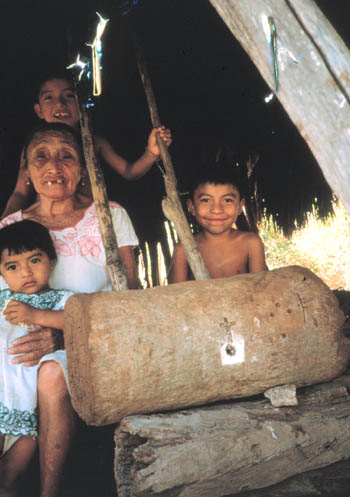
Female stingless beekeeper in Yucatan, Mexico
Stingless bees (Apidae, Meliponinae) for the pollination of greenhouse crops
The diversity of honey-producing tropical bees, that are in their
evironment the most important natural pollinators of tropical flora,
offers important economic prospects for the pollination of greenhouse
crops in tropical and temperate regions. In various international
institutes pollination experiments with pollinating stingless bees form a promising line of research.
The importance of bees in Central America
The indigenous stingless bees (Apidae Meliponinae) of tropical America are very diverse and numerous. Here they are by far the most important pollinators of natural flora and of many tropical crops. Originally, the honeybee (Apis melifera) did not occur in the Americas. After the discovery of the New World, hives of European Apis melifera were introduced. The excellent flora made Mexico and other tropical American countries become major honey exporters.
Meliponiculture: Pre-Colombian beekeeping of stingless bees in Meso America
In contrast to the above development, traditional beekeeping with the less productive native stingless bees gradually obtained the status of a primitive enterprise. Many species of stingless bees are still kept in all Central American countries and Mexico. But "meliponiculture" is usually very inefficient. Due to the ignorance of their biology there is no proper technology. Often honey is collected from natural colonies in the forest. This usually leads to the destruction of the nests. Other colonies are housed in old logs and sometimes even in cardboard boxes. The owners have no knowledge about the natural multiplication of their colonies. During the harvest the stores are removed from the nest. The honey is squeezed out of the large storage pots that are arranged in compact clusters. Since honey pots are mixed with pollen pots, a considerable amount of stored
pollen is lost during its operation.
The nest cavity in log-hives that only have narrow openings at both ends is often difficult to access. Part of the brood may be destroyed when the honey is taken out. Therefore, colonies suffer badly from the harvest. Only after a long recovery, they will start reproducing an excess of food stores again.
Problems with introduced aggressive honeybees
In an effort to improve honey production, aggressive honeybees from the African continent were introduced into Brazil in 1957. These bees crossed the Panama Canal in 1982 and have now spread over Central America, Mexico and even Texas. They mix easily and are very competitive with domesticated honeybees. They are suitable for beekeeping, but give many problems in relation to their great defensive
behaviour.
Involvement in bee research development and beekeeping development in the
tropics
For many years, the Bee Research Group of Utrecht University (Faculty of
Biology) has been involved in advisory and practical activities connected with the technical development of tropical beekeeping. Mainly, these activities
were based on the departments' research programme, concentrating on the biology of tropical bees and derived from the involvement the institution in beekeeping activities in The Netherlands and the tropics. In the period before 1976, extensive experience with beekeeping operations and agricultural and small farming systems in South and Central America was obtained. From that date onwards Utrecht University carried out many bee research projects in the tropics, mainly in Central and South America.
Utrecht University intensified the involvement in the study of tropical bees, especially in the practical development of tropical beekeeping when, in 1987, cooperation with the Universidad Nacional, Heredia, Costa Rica, and other Central American institutions resulted in the establishment of the Cooperative Regional Project for Bee Research and Beekeeping. This project was funded by the
Netherlands' Directorate General for International Cooperation (DGIS) in collaboration with the
Netherlands organisation for International cooperation in higher education
(NUFFIC). That, the programme of Utrecht university for the development of bee research and rural beekeeping in the Central American region also implied cooperative research in Trinidad and Tobago, in Surinam and in Vietnam. Because of the important cultural and socio-economic aspects there
was a strong input by the
department of Cultural Anthropology.
History of the cooperative bee research project in Costa Rica
The first 'Proyecto Regional de Meliponicultura' started as a project of
the DGIS Research Programme in February 1990. It was followed by a new
project, which included an apicultural component; extension and education
were added. This project was operated within the context of the new
MHO/NUFFIC/DGIS programme. The first phase, entitled 'Proyecto Regional de
Apicultura Y Meliponicultura', was from 1992 to June 1997. The second
phase started in July 1997 and this programme lasted
officially until July 2005.
|